ارثنگ (Arthang)
تاریخ هنر (گزیدۀ 'گفتارها، یادداشتهای پراکنده، مقاله و پژوهشها)
ارثنگ (Arthang)
تاریخ هنر (گزیدۀ 'گفتارها، یادداشتهای پراکنده، مقاله و پژوهشها)سنتهای دیداری دیوارنگاری سغدی در نسخهآراییهای جبال و جزیره در سنجش با آرای گیتی آذرپی
انتشار مقالۀ «سنتهای دیداری دیوارنگاری سغدی در نسخهآراییهای جبال و جزیره در سنجش با آرای گیتی آذرپی
مریم کشمیری (دانشیار گروه نقاشی، دانشکده هنر، دانشگاه الزهرا)
نشریۀ هنرهای صناعی خراسان بزرگ، بهار ۱۴۰۵، دورۀ ۴، شمارۀ ۱۳، صفحات ۸۰ تا ۹۴.
چکیده
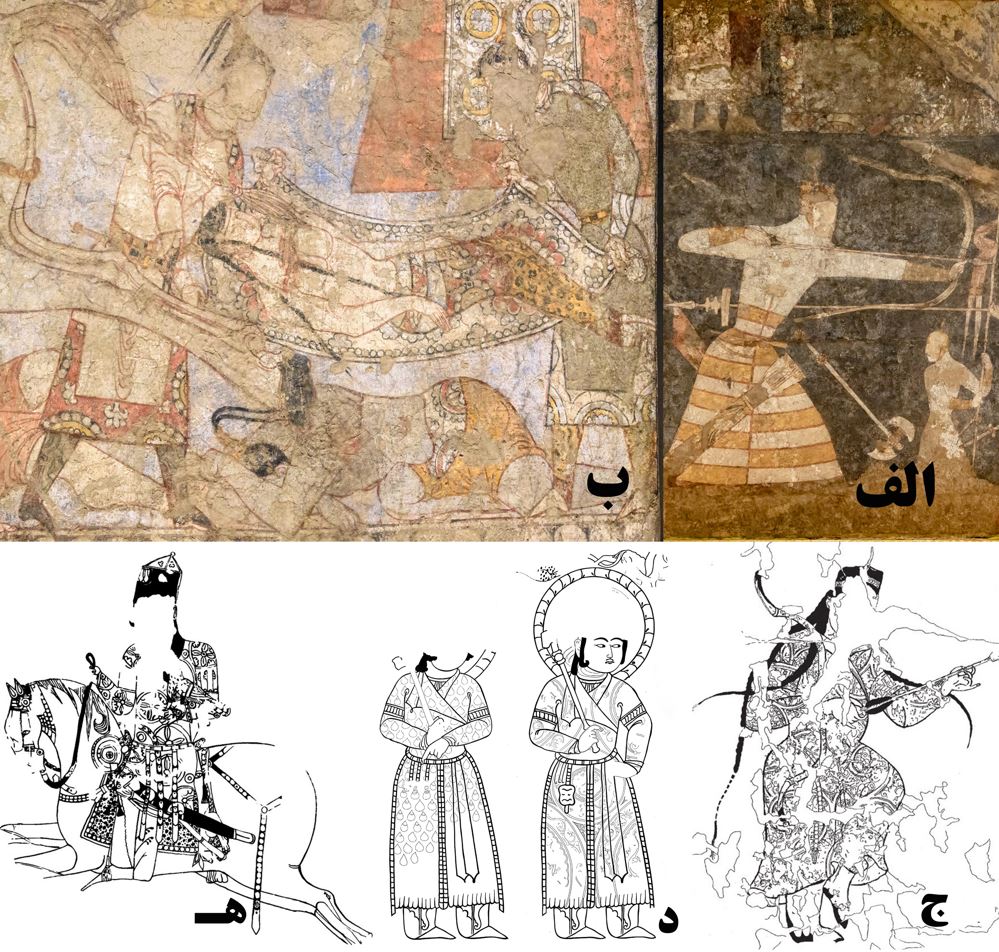
درپی شناسایی آبشخورهای هنر دورههای آغازین اسلامی (پیشامغول)، پژوهشها در یک سدۀ پیش، سویههای گوناگونی را کاویدهاند، از میراث مسیحیان میانرودان و زردشتیان ساسانی تا سغدیان ایرانیمآب و فرهنگ آمیختۀ بوداییـمانوی ترکستان. یکی از آخرین دیدگاهها در این مسیر، از آنِ گیتی آذرپی است که برپایۀ چیرگی فرهنگ عربی در نسخهآرایی پیشامغول، دیوارنگارههای فرعی سغد با مضامین عامیانه و غیرحماسی را اثربخشترین ژانر هنر خاوری بر هنر دوره اسلامی میداند. پژوهش حاضر، بربنیانِ جداسازی نسخههای یادشده در دو گروهِ آثار جبالـجزیره (متأثر از فرهنگ خراسانی) و بغداد (متأثر از فرهنگ عربی)، به هدف سنجش دریافت آذرپی و شناسایی جایگاه اثربخش حماسهنگاری سغد (در جایگاه مهمترین ژانر هنری تمدن فرارود)، سویههای این اثربخشی را به پرسش میگذارد. در این مسیر، ده نسخۀ جبالـجزیره (بربنیان ویژگیهای سبک و آرای هنرپژوهان پیشین) و 26 دیوارنگارۀ فرارود به شیوههای توصیفیـتحلیلی واکاوی شدند و اثربخشی سنتهای حماسهنگاری در دو گروه سامان یافتند: نخست، بازنماییهای برآمده از زیست فرهنگی سغدیـترکی که مهاجران ترک از فرارود به جبالـجزیره آوردند (مانند بازنمایی زنان جنگاور، نمایش نیروهای آسمانی)؛ دوم، روگرفت از نقشمایهها و شیوههای هنر سغدی (مانند پسزمینههای رنگی، ریزنگاری رزمجامهها و ترکیببندیهای متعادل). واکاویها نشان دادند، آنچه از سنتهای فرهنگیـهنریِ مهمترین نمود هنر سغد، یعنی حماسهنگاری به ترکان فرارود رسید، در شاهراه تمدنی خراسان تا جزیره پیش رفت و نسخهپردازی ممتاز پیشامغول در این سرزمینها را جدا از تکاپوهای هنری عباسیان(بغداد) و مملوکیان(شامات) رقم زد. دربرابر دریافت آذرپی باید گفت، بهسبب چیرگی فرهنگ ایرانی در این حوزه تمدنی، سنتهای دیداری حماسهنگاری در نسخهآرایی این نواحی، نمودی چشمگیر دارد.
واژگان کلیدی
دیوارنگاری سغدی، پنجکنت، افراسیاب، سمرقند، نسخهآرایی جبال، نسخهآرایی جزیره
مقاله را در وبسایت نشریه، اینجا ببینید.
مقاله را از اینجا دریافت کنید.
The Manifestation of Sogdian Mural Painting Visual Traditions in the Manuscript Illumination of Jibal and Jazira: a critical assessment in relation to the views of Guitty Azarpay
Maryam Keshmiri
Associate Professor, Department of Painting, Faculty of Art, Alzahra University
Abstract
Since Thomas W. Arnold discussed the origins of Islamic art in his book Painting in Islam (1928), highlighting the role of the Manichaeans of Turkestan and the Christians of Mesopotamia, a considerable body of scholarship has addressed these beginnings. Alongside this perspective, and concurrent with the expansion of archaeological excavations in the Sogdian city-states of Transoxiana, including Panjikent, Afrasiab (Samarkand), Varakhsha, and Shahristan, a new chapter in Islamic art research emerged, emphasizing the influence of Sogdian art on pre-Mongol art. One of the most recent theories in this field was proposed by Guitty Azarpay. Familiar with the distinction between artistic genres in Sogdian murals, including epic painting, ritual paintings, and popular narrative scenes, she writes in part of her book Sogdian Painting (1981) that, because Sogdian epic painting, with its Iranian–Eastern themes, was incompatible with the sensibilities of Arab peoples, reflections of the minor genre of Sogdian painting, namely popular narrative scenes, can be found in Arabic books from Iraq, such as Kalila wa Dimna and the Maqāmāt of al-Hariri.
Taking Azarpay’s argument into consideration and drawing on historical evidence concerning the migration of Turkic peoples—particularly the Seljuks—from Transoxiana to Khurasan, Rayy, and Azerbaijan, and subsequently to northern Iraq (centered on Mosul) and southeastern present-day Turkey, the present study adopts the theoretical premise that some forms of manuscript production in pre-Mongol Mesopotamia were supported by peoples who had migrated to these regions with Eastern–Iranian cultural sensibilities, centered on Greater Khurasan. This raises the following question: given the affinity between the cultural sensibilities of Turkic peoples and Iranian–Eastern epics, what influence did Sogdian epic painting exert on manuscripts produced in Rayy and Azerbaijan in Iran, the cities of northern Iraq (such as Mosul), and southeastern present-day Turkey (such as Diyarbakır and Mardin)? Following the geographical terminology of the early Islamic world, this study refers to the aforementioned territories as Jibāl and al-Jazīra. The phrase “Manuscript Illumination of Jibāl and al-Jazīra” in the article’s title derives from this geographical designation.
This study proceeds on the basis of two groups of visual evidence. The manuscript illumination traditions of Jibāl and al-Jazīra are described through an examination of ten prominent manuscripts from these regions whose significance and attribution are generally accepted by scholars. Sogdian epic-painting traditions are identified descriptively on the basis of 26 non-Buddhist Sogdian murals, particularly those from Panjikent, Afrasiab, and Shahristan. The next step involves matching and comparing the features identified in the works selected during the preceding descriptive stages, followed by a diachronic reassessment from a historical perspective.
This article compares the visual traditions of illustrated manuscripts from the Islamic period with Sogdian epic painting along two distinct lines:
1. Visual traditions in Islamic-period manuscripts rooted in the cultural life of the Turkic peoples who migrated to the territories of Jibāl and al-Jazīra. At least two subjects can be examined in this regard:
1.1. Depictions of prominent and warrior women: Sogdian painters did not restrict the representation of warriors to men. In the culture of this region, warrior women were as important as their male counterparts, and a considerable number of Sogdian murals, such as the battle of the Amazons, attest to this status. Like Sogdian epic painting, the manuscripts of Jibāl and al-Jazīra likewise depict warrior women or women of prominent social standing. At least two manuscripts, Varqa and Gulshāh and the Maqāmāt of al-Hariri, attributed to northern Mesopotamia, display this characteristic.
1.2. Depictions of celestial bodies: In continuity with Sogdian beliefs, in which Nana was among the venerated deities, the Transoxanian Turks continued to believe in the supernatural power of celestial bodies, particularly the Moon. Manuscripts such as Kitāb al-Diryāq in the National Library of France and al-Aghānī depict the crescent Moon above the heads of rulers and manuscript patrons.
2. This study demonstrates that, alongside motifs rooted in deep-seated cultural and social traditions, certain artistic forms and techniques were also reproduced irrespective of their meanings. Examples include:
2.1. Red and blue backgrounds, sometimes incorporating animal motifs and arabesques: Unlike the miniatures of Baghdad, paintings from Jibāl and al-Jazīra characteristically feature uniform colored backgrounds, which are sometimes embellished with various ornaments. This tradition became widespread through the imitation of the background treatments found in Sogdian epic murals, such as the Blue Hall at Panjikent and the Red Hall at Varakhsha.
2.2. Artists’ emphasis on depicting details of military attire: The importance of warfare in Sogdian culture and, subsequently, in the culture of migrant Turkic peoples led to particular care and precision in depicting military garments and horse trappings in battle scenes. Such meticulous attention was especially common in Sogdian murals depicting battle scenes.
2.3. Balanced composition: In Sogdian ritual murals, which were painted alongside epic scenes to celebrate and commemorate their events, a particular compositional arrangement was common, organized around a central figure and a circular composition. This compositional scheme also held a special place in the Buddhist–Manichaean murals of Eastern Turkestan. In the opening pages preceding the main text, manuscripts from Jibāl and al-Jazīra employ the same composition to honor the manuscript patron.
A comparison of Sogdian epic murals with paintings in manuscripts from Jibāl and al-Jazīra, which reflect Eastern–Iranian traditions, demonstrates that the art of the Islamic world before the Mongol invasion was influenced by Sogdian works along two distinct trajectories. Alongside the influence of popular narrative painting traditions on Arabic manuscripts from Baghdad and southern Mesopotamia, Egypt, and the Levant, as emphasized by Azarpay, manuscripts produced in the more northerly regions along the principal route from Greater Khurasan to northern Iraq and southeastern Turkey were strongly influenced by Sogdian epic-painting techniques, reflecting the Iranian cultural inclinations of their patrons. Undoubtedly, the findings of this study offer scope for further investigation and development in several directions. It is possible that a broader understanding of Sogdian art, to be achieved through future archaeological excavations, will reveal further and more complex aspects of its influence on the manuscript illumination of Jibāl and al-Jazīra.
Key Words
Sogdian Murals, Panjikent, Afrasiab, Samarqand, Early Islamic Manuscripts, Jibal Manuscripts, Jazira Manuscripts.
See article Here.
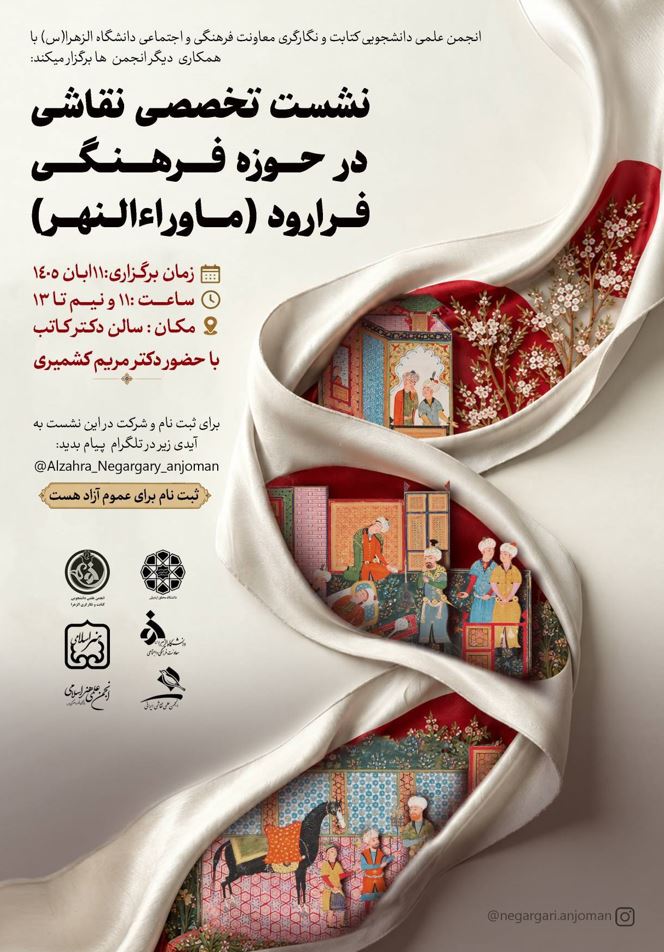
مروری بر مکاتب نگارگری
انجمن علمی دانشجویی کتابت و نگارگری دانشگاه الزهرا برگزار میکند:
مروری بر مکاتب نگارگری
آمفیتئاتر دانشکده هنر، دانشگاه الزهرا
در دو گروه مجزا:
دوشنبهها ۲ و ۹ آذرماه ۱۴۰۵
سهشنبهها ۳ و ۱۰ آذرماه ۱۴۰۵
ساعت ۱۲:۴۵ تا ۱۴:۱۵
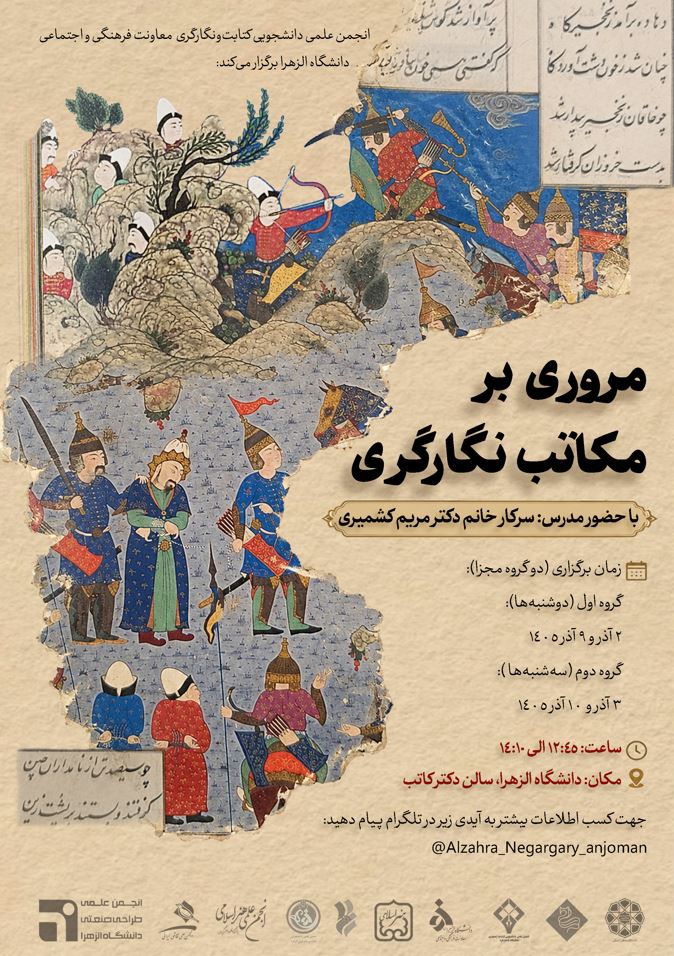
نقاشی در حوزه فرهنگی فرارود (ماوراءالنهر)
انجمن علمی دانشجویی کتابت و نگارگری دانشگاه الزهرا با همکاری دیگر انجمنها برگزار میکند:
نشست تخصصی
نقاشی در حوزه فرهنگی فرارود (ماوراءالنهر)
آمفی تئاتر دانشکده هنر دانشگاه الزهرا
۱۱ آبانماه ۱۴۰۵
ساعت ۱۱:۳۰ تا ۱۳
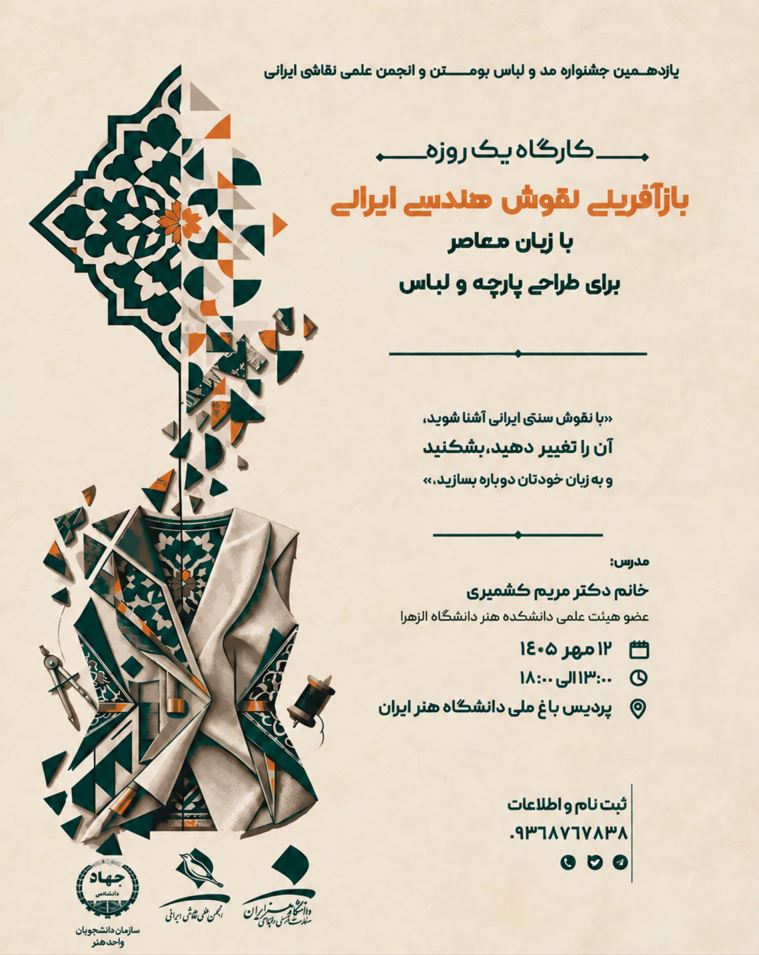
بازآفرینی نقوش هندسی ایرانی
یازدهمین جشنواره مد و لباس بومتن با همکاری انجمن علمی نقاشی ایرانی دانشگاه هنر ایران برگزار میکند:
کارگاه یک روزه
بازآفرینی نقوش هندسی ایرانی
با زبان معاصر برای طراحی پارچه و لباس
۱۲ مهرماه ۱۴۰۵
پردیس باغ ملی دانشگاه هنر ایران
ساعت ۱۳ تا ۱۸
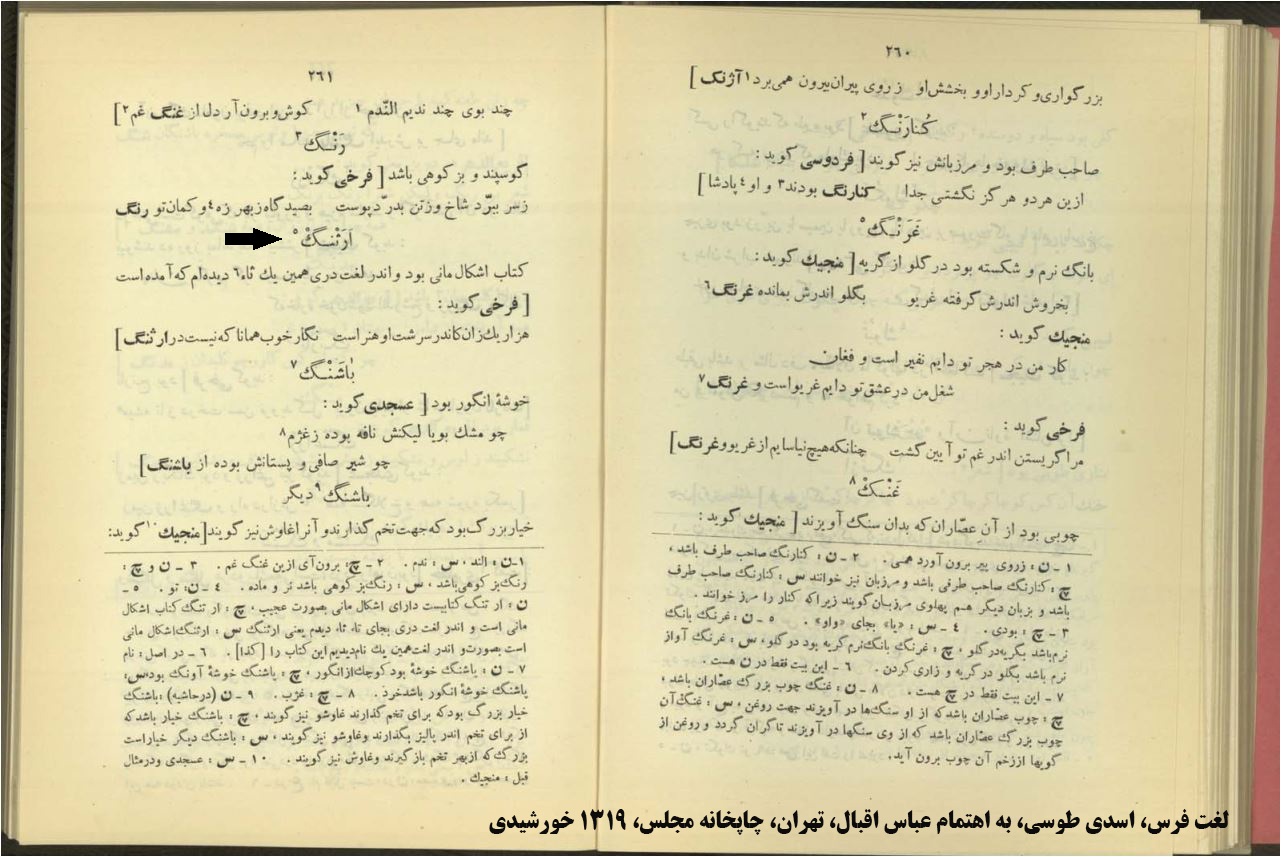
برخورد هستیشناسانۀ مولانا با نقاشی در پارههایِ غزلی از دیوان کبیر
مقالۀ «برخورد هستیشناسانۀ مولانا با نقاشی در پارههایِ غزلی از دیوان کبیر»
نشریۀ هنرهای زیبا: هنرهای تجسمی (دانشگاه تهران)، دوره ۳۱، شماره ۱، بهار ۱۴۰۵، صفحات ۷۳ تا ۸۵.
نویسنده: مریم کشمیری (استادیار گروه نقاشی دانشگاه الزهرا)
چکیده فارسی
زیر بار سنتهای بازنمایی پیشااسلامی، نقاشی در اسلام با این گناه بزرگ روبهرو بود که درپی هماوردی با آفرینش الهی است. از اینرو، سخنان مولانا دربارۀ شمایلشکنی، سنت نقاشی بیزانسیـمسیحی و نقاشی در اسلام، نگرش دگرگونهای را بازمیتاباند. پژوهش در این چارچوب به این پرسشها میپردازد: بنمایههای نگرش مولانا به نقاشی چیست؟ او چگونه میان جنبش شمایلشکنی، چهرهنگاری بیزانسیـمسیحی و نقاشی در تمدن اسلامی مرزبندی میکند؟ هدف پژوهش، بررسی چالشهای نقاشی از چشمانداز الهیات، خوانش غزل مولانا با رهیافت تصویری و شناخت نگرش تأویلگرایانه او به نقاشیست. از دید روششناسی، بررسی تاریخی پایة مطالعه است. این بررسی همراه با کاربردشناسی واژگان و مفاهیم در بافت سخن مولانا و گزارشگران همروزگار در سنجش با نمونههای تاریخیِ بازنمایی پیش میرود. منابع، کتابخانهای است؛ پارهای از مفاهیم و سخنان مولانا دربارۀ نقاشی، همبستگی باورها و دیدگاههای او با آموزههای وحیانی و چیرگی روش عرفانی بر سخن مولانا، تکیهگاههای نظری پژوهش است. پژوهش نشان میدهد مولانا در رویارویی با چالش بازنمایی روح، میان نقاشی جسمانی و روحانی تمایزگذاری میکند. برپایة این تمایزگذاری، خداوند روح را در حرکت دائمی میآفریند و تصویر میکند، اما هرچند نقاش، روح را مینمایاند، کار او، بازنمایی در حالت ایستا است، چنین نقشی در جایگاه هماوردی با آفرینش الهی نمیایستد.
واژگان کلیدی
غزلیات شمس، روان ساکن، شمایلشکنی، نقاشی جسمانی، نقاشی روحانی
مقاله را در وبسایت نشریه در اینجا ببینید.
مقاله را از اینجا دریافت کنید.
Mawlana's Ontological Encounter with Painting in Selected Verses from the Diwan-e Kabir
Maryam Keshmiri
Abstract
Pre‑Islamic traditions of representation in Egypt, Mesopotamia, and India fostered the belief that painting was a great sin, as the painter was seen as challenging God. Consequently, the words of Mawlana Jalal al‑Din Muhammad, the 13th‑century Persian poet and mystic, in works such as the Maṯnawi and the Ghazaliat‑e‑Shams, reflect an alternative perspective on iconoclasm, the Byzantine Christian painting tradition, and the role of painting in Islamic civilization. We pose the following questions: What are the primary themes in Mawlana’s perspective on painting? How does he reconcile the iconoclastic movement, Byzantine Christianity portraiture, and the continuity of painting in Islamic civilization based on religious teachings? The study seeks to conceptualize Mawlana’s mystical approach to painting. The primary objective is to examine the historical challenges in perspectives on painting from a theological standpoint. The aim is to employ a visual approach in reinterpreting Mawlana’s ghazal and to reassess his hermeneutical view of painting. Methodologically, this study is grounded in historical analysis through the pragmatic examination of lexicon and concepts within the context of Mawlana’s discourse and that of his contemporaries. The comparison between the notions and surviving examples of paintings from the traditions of Egypt, Mesopotamia, ancient Byzantine, and Islamic civilization seems necessary. The premises include an exploration of Mawlana’s statements and concepts regarding painting, the derivation of his beliefs from Islamic teachings, and the influence of Sufism and mysticism on his thought. The concepts and fragments of his ghazals reveals that Mawlana, by distinguishing the corporeal painting and spiritual, seeks to resolve the dilemmas associated with painting, and demonstrate that the mere act of painting is not inherently sinful. Mawlana’s ghazal constitute a multilayered dialogue. Internally, this dialogue unfolds between the self and the soul, while externally, it occurs between the painter and the subject, advancing within the framework of iconoclasm on one hand and the potentials of representation on the other. From an iconoclastic perspective, engaging in the act of painting brings immense torment to the painter. Moving from the experience of tangible representation to mystical experience, Mawlana invites painting to transition from similitude (resemblance) to transcendence (purification/mirroring). Then mystical experience grounded in revelatory theology does not abolish painting but rather transforms its perception and interpretation into a liberating act within a hermeneutical framework. The painter, by gazing at the subject, cannot truly animate the image unless he transcends the superficial layer and perceives the unseen soul in stillness. Nevertheless, the painter remains the representative of the soul’s infinitude in a fleeting moment and cannot fully grasp and depict the entirety of the soul’s grandeur. This is articulated in one of Mawlana’s ghazals at a time when painting in Islamic civilization was undergoing a crucial transformation, marking the emergence of major artistic schools in Iran. In Mawlana’s perspective, theoretical ideas concerning Egyptian, Byzantine Christianity, and Baghdad School painting traditions converge. This perspective marks the beginning of painting’s journey in Islamic civilization toward rediscovering its theoretical foundations and new functions.
Key words
Ghazaliat-e Shams, Divan-I Kabir, Islamic Paintings, Iconoclasm
See the article Here.
آموزش هندسه در دارالفنون، راهگشای نگرشِ آکادمیک به نقاشی در ایران
مقالۀ «آموزش هندسه در دارالفنون، راهگشای نگرشِ آکادمیک به نقاشی در ایران»
نشریۀ هنرهای زیبا: جلوه هنر (دانشگاه الزهرا)، دورۀ ۱۸، شماره ۲، پیاپی ۵۱، تیرماه ۱۴۰۵، صفحات ۱۲۹ تا ۱۵۳.
نویسنده: مریم کشمیری (استادیار گروه نقاشی دانشگاه الزهرا)

چکیده فارسی
در تاریخنگاری هنر قاجار، دگرگونی نقاشیِ ایران را پیامد فعالیتهای دارالفنون و مجمعالصنایع میدانند. این دیدگاه هرچند رواج گستردهای یافته است، پرسشهای اصلی را بیپاسخ میگذارد: دگرگونی نقاشی در ایران برآمده از چه آموزههایی بود؟ و نشانههای این دگرگونی در پیوند با کدام نهادها پدیدار شدند؟ پژوهش حاضر با فاصلهگیری از روایت رایج میکوشد سرچشمههای واقعی نقاشی آکادمیک در ایران را در پیوند با آموزهها و نهادهای تأثیرگذار شناسایی کند. چارچوب نظری پژوهش بر توجه به تأثیرپذیری نقاشی از دستاوردهای علمی و آموزشی غرب و چگونگی بازتاب آن در ایران استوار است. روش کار تاریخی ـ تطبیقی است و بر تحلیل واژگان، مفاهیم، طرحها و گونههای بازنمایی در منابع کتابخانهای و آرشیوی تکیه دارد. بازه زمانی بررسی، دو دورة نخست دانشآموختگی فعالیتهای دارالفنون را دربرمیگیرد. بررسیها نشان میدهد که دگرگونی نقاشی نه از مسیر آموزشهای مجمعالصنایع، بلکه در بستر درسهای دارالفنون رخ داد. درس هندسه پیشرفتۀ دارالفنون که در امتداد سنتهای هندسه توصیفی در فرانسه قرار داشت، امکان تعریف تازهای از بازنمایی را فراهم کرد و به نقاشان ابزار مفهومی و روش اجرایی برای سازمان دادن به قواعد پرسپکتیو داد. این فرآیند توضیح میدهد که چرا نقاشی آکادمیک با نگرش هندسی و رشته مهندسی پیوند یافت. در سطحی گستردهتر، این نتیجه با تحول همزمان در اروپا سنجیدنی است: پس از نوآوری نقاشان اروپایی در سامان دادن به چارچوبهای پرسپکتیو، ریاضیدانان فرانسوی بنیانهای ریاضیاتی بازنمایی را در قالب هندسه توصیفی تدوین کردند. از این رو میتوان گفت دگرگونی نقاشی در ایران بهویژه از آموزش هندسه در دارالفنون بهشیوۀ اروپایی سرچشمه گرفته است.
واژگان کلیدی
دارالفنون، مناظرومرایا، نقاشی، نقشه، هندسه
مقاله را در وبسایت نشریه در اینجا ببینید.
مقاله را از اینجا دریافت کنید.
The article’s approach to addressing these questions is historical–comparative and interdisciplinary. This method rests on three foundations: (a) historical research through the critical examination of documents, contemporary reports, and curricula; (b) a comparative method that measures the teachings and educational structures of Dār al-Fonūn against equivalent European, especially French, examples; and (c) applied conceptual analysis, which places the vocabulary and concepts related to painting and drawing (including perspective-making, maps, simulation, the rule of proportion, and so on) alongside images, examples, and data surviving from different branches of the sciences so that the transformation, in connection with the terms, becomes evident through their applications. The data used consist of a combination of archival documents, contemporary newspaper reports (including Vaqāyeʿ-Ettefāqīya), the curricula of Dār al-Fonūn, translated books, and surviving images in the educational books of that period.
A review of the research literature shows that previous studies on the transformation of Qajar-period painting are scattered, and no consensus exists regarding the teachings, institutions, and instructors. Some studies, such as the writings of Willem Floor and Ya‘qub Āzhand, have emphasized the connection between the teachings of Dār al-Fonūn and technical transformation, yet certain shortcomings remain in the attribution of developments to workshops and individual schools (such as the classes of Ṣanīʿ al-Molk). Other studies (from the 2000s onward) have examined the Majmaʿ al-Ṣanāyeʿ, the presence of European teachers, the dispatch of graduates to Europe, and the introduction of perspective; however, the precise origin of academic instruction in painting and its relation to geometric training at Dār al-Fonūn required a reidentification of the theoretical teachings. This study emphasizes precisely these necessities and seeks to reconstruct the educational origin of the transformation.
The article’s historical and theoretical background relies on the established connection between geometry, geography, and representation. The Islamic scientific tradition—from Fārābī and Bīrūnī to later technical works—recognized links between optics, geometry, and drawing to distinguish erroneous from correct perception. Meanwhile, in Europe, from the Renaissance onward, painting and the new sciences—especially geometry and optics—systematized perspective and enabled formal instruction in drawing and descriptive geometry. These European educational models, especially within the French engineering tradition, shaped the new instructional framework adopted by Dār al-Fonūn.
The empirical evidence of the article is primarily drawn from the documents of Dār al-Fonūn and newspaper reports. The reports of Vaqāyeʿ-Ettefāqīya in the first decade of Dār al-Fonūn show that, even at the beginning of the educational process, the words “painting,” “map-drawing/drawing,” “figure,” and “image” had no clear boundaries and were used interchangeably for different types of drawing (from geographical maps to geometric diagrams and instrument design). In the textbooks translated or compiled during that period (including the works of Kresisch and other teachers), “figure” was often the general term for colorless images, and some of what we today call “maps” were recorded in the texts of that time with the term “figure” or “map.” This methodological point reveals the importance of accurately matching vocabulary with visual examples.
Analysis of the curricula and the contents of educational books shows that the geometry course in Dār al-Fonūn was a combination of arithmetic, theoretical geometry, qavāʿed-e mohkamme (rigorous rules), and some topics related to optics and engineering drawing. In contemporary descriptions, “the special course of geometry” was reported to include “the higher subjects of geometry from the rigorous rules and the art of painting and the science of geography.” Although perspective and graphic geometry were not discussed in some standard texts, the records of classes and books (including ʿElm-e Mesāḥat and the books of Kresisch) show that topics such as drawing shapes, measuring surfaces, subjects of geometric geography, and drawing views and optics were present in the curricula. Therefore, at the beginning of Dār al-Fonūn, painting was mainly taught as a practical skill within the framework of geometric and engineering instruction, and not as an independent art in the sense of the master–apprentice tradition of the Majmaʿ al-Ṣanāyeʿ.
Based on this evidence, the main finding of the article is that the technical transformation of Qajar-period painting was founded on the teachings of geometry and especially descriptive geometry. The examination of documents from the first three decades of Dār al-Fonūn’s activity showed that concepts such as perspective, map-drawing, and methods of engineering drawing found their way from the geometry course into the practical field of painters and laid the theoretical foundation of academic representation for Iranian painting. Therefore, the foundation of this transformation should not be sought merely in the imitation of foreign styles; rather, it must be seen in the transmission and indigenization of geometric knowledge that had taken shape in the European educational tradition and was established in Dār al-Fonūn as a fundamental teaching for painting education.
The research showed that the central institution in this transformation was Dār al-Fonūn; contrary to some accounts, the Majmaʿ al-Ṣanāyeʿ did not have a foundational role in the formation of this geometric–academic conception.
The early curriculum of Dār al-Fonūn comprised elementary geometry, the leveling of lines and surfaces, and basic drawing exercises. It gradually expanded to include graded descriptive drawing, the science of perspective, rules related to carpentry and stonework, and various forms of design and coloring. All these subjects were closely tied to painting and reveal that mastering representational frameworks required prior knowledge of mathematics and descriptive geometry. Without such knowledge, the theoretical foundations of perspective and its application to painting could not be understood. Only engineering students, after completing general mathematics, were allowed to study the advanced course that included rigorous geometrical rules and the art of painting. This explains why the name of Ṣanīʿ al-Mulk does not appear among the earliest instructors of Dār al-Fonūn: the new topics in painting were first introduced in engineering classes and only later reached artists.
Lists of the first painting instructors at Dār al-Fonūn always begin with teachers of geometry—such as Malcom and others—followed by Kazer Polot, Constant, and Muzzayyin al-Dawla. Kamāl al-Mulk’s remark about Muzzayyin al-Dawla—that “although he lacked innate taste, he possessed the foundations of schooling”—points to the theoretical orientation of painting instruction at Dār al-Fonūn, where training was grounded in mathematical and geometric principles of representation. Najm al-Dawla likewise stressed that unless a painter was also an engineer, trained in geometry and the science of perspective, he could not correctly render proportion, distance, and chiaroscuro.
Names such as Jaʿfar-Qolī Khān, Ẕūlfiqār Beg Maḥallātī, Moḥammad-Taqī Moqaddam, and Mīrzā ʿAlī-Qolī repeatedly appear in colophons and instructional illustrations of the 1270s AH. Their activity shows that they learned the rules of painting not in traditional workshops like the Majmaʿ al-Ṣanāyeʿ, but in advanced geometry classes under Dār al-Fonūn instructors. Geometry courses at the institution—directly linked to the pedagogical tradition of French mathematicians—provided the framework through which painting could move from a traditional craft to an academic discipline, establishing the principles of perspective and scientific representation in Iran.
The article’s integrated method—bringing together curricula, teachers’ notes, newspaper reports, and visual examples—makes it possible to map the trajectory and timing of the dissemination of key concepts in academic painting. On this basis, the transformation can be understood in two stages: first, the incorporation of geometry into the curriculum of Dār al-Fonūn, which connected painting to mathematical knowledge and laid the theoretical groundwork for academic representation; and second, the introduction and spread of European styles, which extended these theoretical foundations into pictorial practices and practical instruction, ultimately consolidating academic painting in Iran.
Overall, the results of the research emphasize that the main origin of Iranian academic painting was Dār al-Fonūn, and that the transformation in the painterly attitude, language, and practice of the Qajar period was the product of the systematic encounter between modern geometric instruction and practical efforts in drawing and painting—a process that was not mere imitation but rather the transmission and indigenization of geometric knowledge, leading to the establishment of the rules of perspective and scientific representation in Iran.
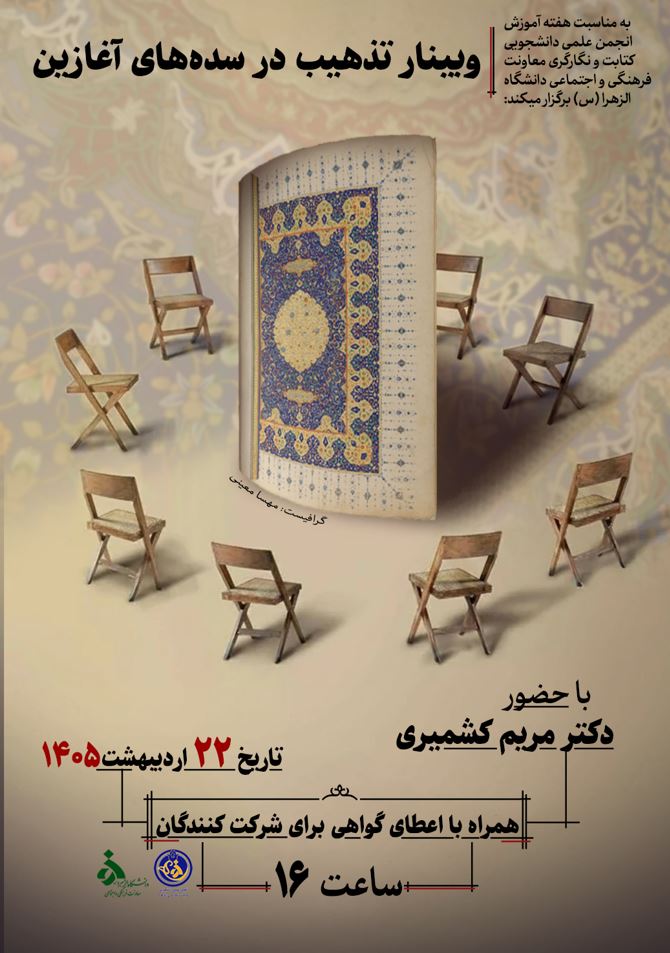
وبینار تذهیب در سدههای آغازین هجری
به مناسبت هفته آموزش، انجمن علمی دانشجویی کتابت و نگارگری برگزار میکند:
وبینار تذهیب در سدههای آغازین هجری
۲۲ اردیبهشت ۱۴۰۵
آمفیتئاتر دانشکده هنر، دانشگاه الزهرا، ساعت ۱۶


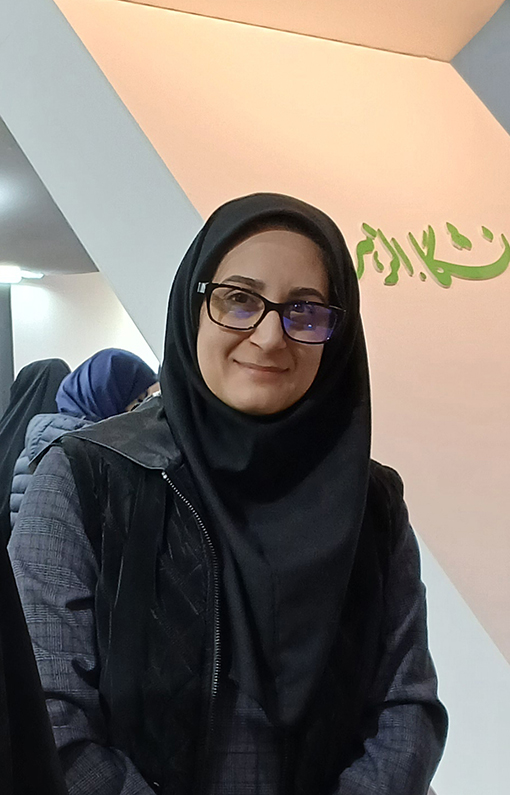
برگزاری کارگاه ریاضیات و نقوش سنتی (هندسه نقوش و تذهیب) در غرفه دانشگاه الزهرا در نمایشگاه بین المللی تهران
کارگاه ریاضیات و نقوش سنتی (هندسه نقوش و تذهیب)
مجری: دکتر مریم کشمیری
مکان: نمایشگاه بینالمللی تهران، سالن شماره ۵، غرفه ۲
زمان: ۲۵ آذرماه ۱۴۰۴ (ساعت ۹ تا ۱۲)
جایگاه نقاشی در سدههای میانی با نگاه به شالوده بازشماری دانشها و هنرها در تمدن اسلامی
مقالۀ «جایگاه نقاشی در سدههای میانی با نگاه به شالودۀ بازشماری دانشها و هنرها در تمدن اسلامی» منتشر شد.
نشریۀ تاریخ علم (دانشگاه تهران)، دورۀ ۲۲، شمارۀ ۲، پیاپی ۳۷، صفحات ۱۰۹-۱۳۲
نویسنده: مریم کشمیری (استادیار گروه نقاشی دانشگاه الزهرا)